Author: Lojean Hersi, PhD Candidate in Politics, King’s College London
When Formal Protection Systems Fail
What happens when the state and humanitarian organizations fail those who are most vulnerable and on the margins of society? Who, in fact, provides protection and support for them throughout the conflict?
Across multiple crises, the same pattern emerges. From earlier emergencies in the region such as Syria to the ongoing horrors in Gaza and Sudan, humanitarian access is systematically blocked or severely constrained.[1]Time and again, the international community pleads with those in power not to forsake the most vulnerable in an effort to prevent human suffering, yet such appeals are often ignored. When those in positions of power fail to provide social protection, support, and stability during times of hardship, individuals are often left with only one remaining source of support: their social networks.[2]
Community Networks as Lifelines
Social networks are more than just the people closest to us – family, friends, and neighbours. They extend through the wider web of relationships that connect individuals and communities. In times of conflict, these networks often become lifelines, shaping how people navigate daily survival. As a result, communities are often best placed to identify urgent needs, understand local vulnerabilities, and navigate the social realities that determine who can and cannot be reached. Through shared information and mutual support, communities help members identify safe routes, avoid dangerous areas, and locate scarce resources such as electricity, internet access, and shelter.
Gaza’s Informal Electricity Networks
In Gaza, essential systems have collapsed under conditions of war and blockade. This has forced communities to depend on one another for survival. Gaza, which was already facing severe electricity shortages prior to 7 October 2023, has descended into even deeper hardship. For more than two years, municipality-supplied electricity has been virtually non-existent as a result of Israel’s complete cut-off of power supplies, a punitive measure that has left residents without a basic service essential to daily life.[3] At the same time, Israel has issued a ban on numerous humanitarian organizations, including ActionAid, Médecins Sans Frontières, and the International Rescue Committee.[4] This ban has made it increasingly difficult for organizations to reach vulnerable populations. In response, many Gazans have been forced to navigate an informal electricity market. For most residents, access to electricity now depends on personal networks and word-of-mouth information about where charging stations may still operate. People often walk hundreds of metres to reach a charging point where they pay informally to charge their phones.[5] These devices have become both a primary source of light and a critical lifeline to the outside world. Charging stations also enable families to charge batteries that power essential medical equipment for children suffering from respiratory conditions.[6] This reliance on informal arrangements reflects a wider breakdown in social protection systems, where people are left to depend on personal relationships and community ties to meet their basic needs.
Daraa’s Informal Water Networks
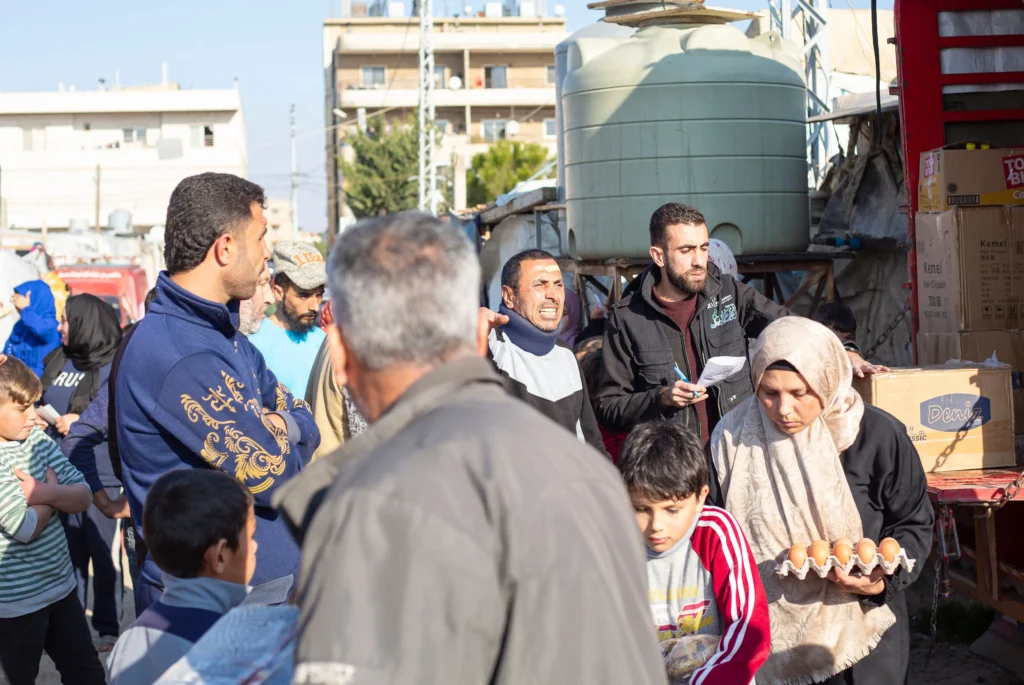
Similar patterns can be seen in other crisis-affected regions where basic services have broken down. Nowhere is this more visible than in Daraa’s escalating water crisis. Water shortages in Daraa, the cradle of the Syrian revolution, have reached catastrophic levels in recent years. As a result of climate change, collapsing infrastructure, and uncontrolled well drilling, some communities in Daraa were receiving water only once a month, sometimes for just a few hours.[7] Beyond being a public service, access to water is one of the most fundamental forms of protection during crises. When that access is disrupted, households are pushed further into vulnerability. Families are often forced to rely on informal networks simply to secure access to water. Some turn to individuals with private wells who sell water directly, while others depend on trucking providers recommended by neighbours or on vendors who may pass through their communities every Friday to deliver water. The situation becomes even more precarious for households without the financial means to pay for these services. In many cases, they must rely on people within their network who have illegally tapped into the public water system and are willing to share or extend a connection so they can access water at all.
The Unequal Reach of Informal Protection
However, the benefits of these informal support systems are not distributed equally. A fundamental challenge for many families living in these conditions is that access to these networks of information, support, and informal services is deeply unequal. When survival depends heavily on who you know and the connections you can access, the loss of those networks through displacement can be catastrophic. Many have been displaced from the neighbourhoods and family networks on which they once relied and have lost countless family members, leaving them without trusted community ties and networks of solidarity. This can make it incredibly difficult for them to navigate new environments, trust those offering help, or access basic necessities such as water, safety, and shelter. These inequalities are often even more pronounced for individuals who already face barriers to participating in community networks, including the elderly and women, who may be disadvantaged due to restricted mobility, social norms, caregiving responsibilities, or limited financial independence. This makes it significantly harder for them to secure basic needs, particularly in the absence of family members or others who can support them.
So how can we meaningfully speak of social protection when states themselves obstruct humanitarian organizations? Rather than viewing protection gaps solely as a consequence of state weakness, it is important to recognize that states can actively shape and deepen these vulnerabilities through exclusion, neglect, or obstruction. The answer may lie in reconsidering where protection actually resides. In fragile and conflict-affected settings, social protection rarely disappears altogether when formal state systems weaken or collapse; instead, it becomes fragmented, decentralized, and embedded within informal social relations. Networks based on kinship, neighbourhood ties, and religious affiliation often emerge as alternative mechanisms of survival and care.
Toward Accountable, Rights-Based Protection
Informal networks are not without their limitations. These arrangements can reproduce local hierarchies, exclude certain groups, or distribute assistance unevenly. Yet dismissing them as merely temporary or illegitimate substitutes overlooks the fact that, in many contexts, they constitute the only functioning infrastructure of protection available to civilians. They are often more adaptive, trusted, and socially embedded than external interventions operating at a distance. In this context, the role of humanitarian organizations extends beyond simply pressuring states to allow access. It also involves recognizing and engaging with the forms of civilian agency that already exist on the ground. By building trusted relationships with local actors and supporting existing community capacities, humanitarian organizations can work through structures that already possess local legitimacy and knowledge. Therefore, humanitarian actors must find ways to support and strengthen local networks while gradually connecting them to more formal, rights-based, and accountable systems of protection. Social protection should be understood not merely as a state-delivered policy, but as a layered and negotiated process shaped by institutions, humanitarian actors, and the social relationships through which people survive when formal systems fail.
[1] Jane Ferguson, “How Assad Blocked Aid to Syrian Earthquake Victims”, The New Yorker, 13 February 2023, available at https://www.newyorker.com/news/dispatch/how-assad-blocked-aid-to-syrian-earthquake-victims; Office of the United Nations High Commissioner for Human Rights (OHCHR), “Israel: Ban on 37 Aid Groups Makes Life Unbearable for Genocide Survivors in Palestine, Say UN Experts”, 15 January 2026, available at https://www.ohchr.org/en/press-releases/2026/01/israel-ban-37-aid-groups-makes-life-unbearable-genocide-survivors-palestine (OHCHR, “Israel: Ban on 37 Aid Groups”); Amnesty International, “Destruction and Violence in Sudan”, available at https://www.amnesty.org/en/projects/sudan-conflict/
[2] International Labour Organization, “Social Protection”, available at https://www.ilo.org/topics-and-sectors/social-protection
[3] United Nations Office for the Coordination of Humanitarian Affairs – Occupied Palestinian Territory, “Electricity in the Gaza Strip”, available athttps://www.ochaopt.org/page/gaza-strip-electricity-supply
[4] OHCHR, “Israel: Ban on 37 Aid Groups”.
[5] Maram Humaid, “Living in the Dark: Gaza’s Struggle for Electricity”, Al Jazeera, 29 March 2026, available at https://www.aljazeera.com/features/2026/3/29/living-in-the-dark-gazas-struggle-for-electricity
[6] Middle East Monitor, “How to Charge a Phone in Gaza: Patience Required, Sunshine Helps”, 16 January 2024, available at https://www.middleeastmonitor.com/20240116-how-to-charge-a-phone-in-gaza-patience-required-sunshine-helps/
[7] Walid Al Nofal, “Drought, Drilling, Diversion: Daraa’s Deepening Water Crisis”, Syria Direct, 23 September 2025, available at https://syriadirect.org/drought-drilling-diversion-daraas-deepening-water-crisis/
Disclaimer: Except for articles published on Blog Tadamon and the content of the resource pages, all materials on this website, including their respective photographs, are indexed from their original sources. All rights remain with the respective copyright holders.